
Trace Gogebic County Former Owners
The newest recorded transfer is the starting point. The Gogebic County Register of Deeds keeps the deed records and links its Land Records Search System. Search the grantor index there first. The county publishes no cutoff date for online coverage, so ask the office before treating a missing online result as the end of the chain.
| Transfer Date | Grantor to Grantee | Deed Type | Book/Page |
|---|---|---|---|
| Newest first | Prior owner to current grantee | As indexed | Copy exact reference |
| Previous transfer | Earlier grantor to that prior owner | As indexed | Copy exact reference |
| Repeat backward | Match one legal description | Note warranty or quitclaim | Continue into books |
Read each entry from the actual instrument. A quitclaim passes only the grantor's interest, while a warranty deed makes stronger promises, so deed type alone never proves a clean chain.
Gogebic Plats Bridge Owner Eras
Plat books bridge owner eras. The Library of Michigan Gogebic guide lists a plat book from the 1930s era, a 1959 volume, and atlas or plat-book runs for 1983 and 1990 to 1991. They link prior owners, roads, lots, and lakes.
Newspapers help too. The guide lists the Gogebic Advocate, Ironwood News-Record, and Ironwood Daily Globe in runs from the 1890s through 2002. A legal notice may flag a probate sale, foreclosure, tax matter, or mining lease. Confirm it in a deed or court file.
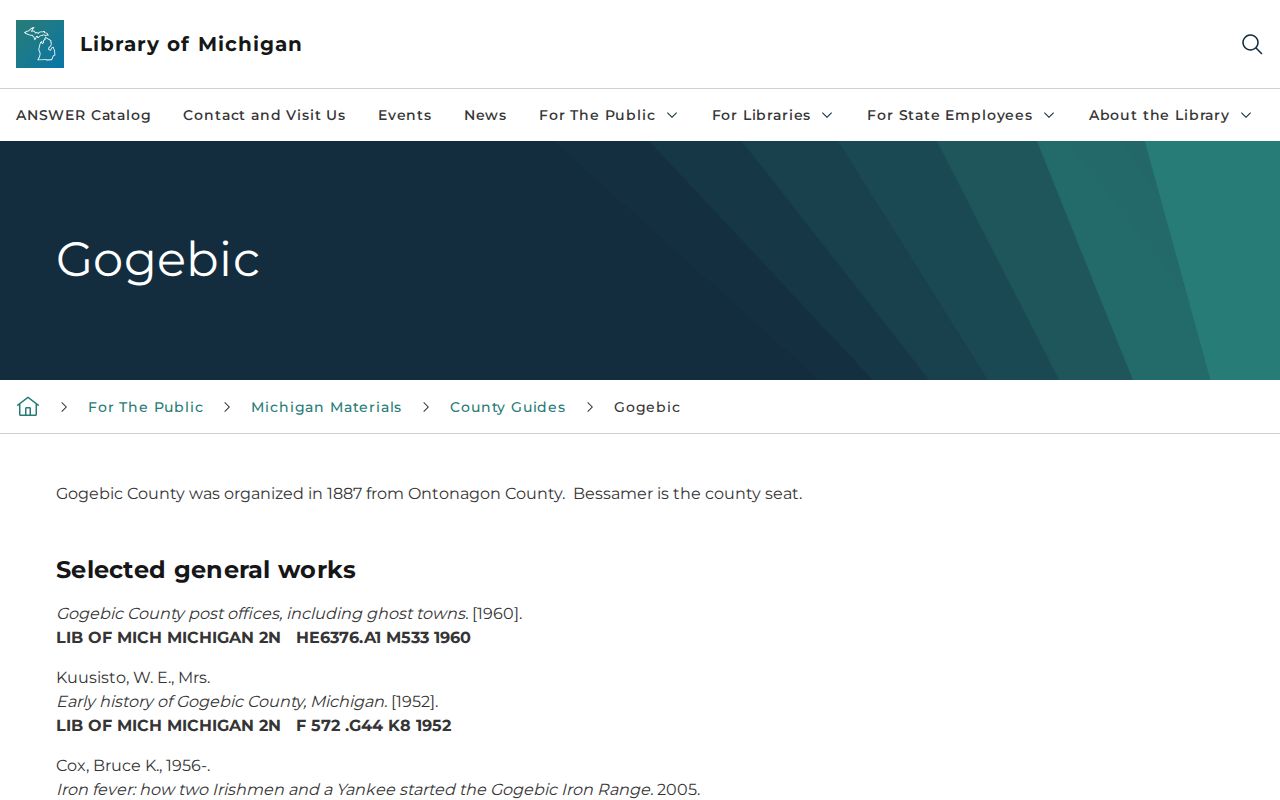
Old address records only reach so far. Official plat and newspaper holdings supply fixed search points when modern indexes stop short of the former owner you seek.
Read Gogebic Deeds Backward
The legal description is the anchor. Streets get renamed and parcels split or merge, but successive recorded descriptions show exactly how the land moved.
- Find the current owner's deed with that owner as grantee.
- Copy the grantor and complete legal description.
- Search that grantor as a grantee on an earlier deed.
- Repeat, then ask for deed books when online coverage ends.
- Grantor
- The party conveying an interest.
- Grantee
- The party receiving it.
- Chain of title
- The ordered transfer sequence.
- Reverse index
- An index used to follow parties backward.
Gogebic Descriptions Outlast Addresses
One public BS&A sample runs deep. It combines section, township, range, a government lot, a subdivision exception, a river boundary, and acreage, while Bessemer's railroad plat, Ironwood's mining-town grid, and Wakefield's Ringsmuth Plat add local patterns. Tie owners to the description. Splits complicate things. When land divides or merges, compare successive deeds, plats, and parcel cards, because a new PIN does not erase the earlier ownership trail.
Probate in Gogebic Owner Chains
Estates can break a simple seller-to-buyer line. A personal-representative deed, fiduciary deed, probate order, or later buyer deed may move the parcel. MiCOURT may show a public case index. The probate clerk controls the file, so match its land description to the recorded transfer.
A probate case alone does not prove ownership. It does not show the estate still held the land at a later date.
Reach Older Gogebic Owner Records
Start with the online portal, then reach the Register by phone, mail, or in person. Give the parties, date range, PIN, and legal description. Ask which deed books, reverse indexes, plat books, and images exist. The Library catalog and archives add old map context.
A local assessor may know whether historic rolls survive for its city or township, and a narrow FOIA request can seek a non-exempt inventory or transfer log. An empty website result proves nothing.
Search Gogebic Prior Owner Names
Names wander. Spellings, initials, marriage, translation, and business formats all shift across the records. Search each party as grantor and grantee, keeping entity suffixes and trustee capacity intact. Then compare dates and legal descriptions to separate people who share a name, and treat newspaper spellings only as clues pointing toward the recorded instrument or controlling court order.
Gogebic Tax Cards Are Partial
A modern tax card is a partial witness. It may list recent tax history, yet it never catalogs every former owner. Use its PIN and description to reach the recorded chain.
Assessment records serve taxation first. Sale fields may skip conveyances. Note the tax-card date and local unit. Then compare each listed transfer with the deed index, because a parcel split, merger, estate event, or delayed recording can make a short tax history look more complete than it truly is.
Gogebic Deed Terms in Context
Write down the details that matter. Record the deed type, party capacity, instrument date, recording date, and exact land description, since those fields explain a quitclaim, fiduciary act, or delayed recording without guesswork.
Dates can diverge. The instrument date is signing day, while the recording date is when the Register accepted the document. A warranty deed and a quitclaim differ in promises. A fiduciary deed signals a representative acting for an estate or another legal interest. Preserve the record's own label.
Check Every Gogebic Transfer
Check the land at every step. A same-name person or a nearby lot can build a false chain if you skip the description.
When the web system fails, keep going by phone, mail, or an in-person index search. The county publishes no earliest year for the portal. Ask which reverse indexes, deed books, images, and plats cover the period. Only then decide whether the chain has truly ended.
Gogebic Ownership Record Depth
The official Register page leaves out a few basics. It names no index cutoff, no earliest book year, and no image start date. Ask the office directly. In-person, phone, and mail requests still carry much of the load for deed records in Gogebic County. A narrow FOIA request can also seek a non-exempt inventory of what the office holds. It is no substitute for actual deed research, so treat it as a starting point. One more caution applies: no official source confirms the old story that a courthouse fire destroyed Gogebic County land books. Flood or renovation notices alone are not proof of lost records.
Coverage limit. The online cutoff is unconfirmed. Older Gogebic owners may require deed books, plats, newspapers, and office help.